
In brief
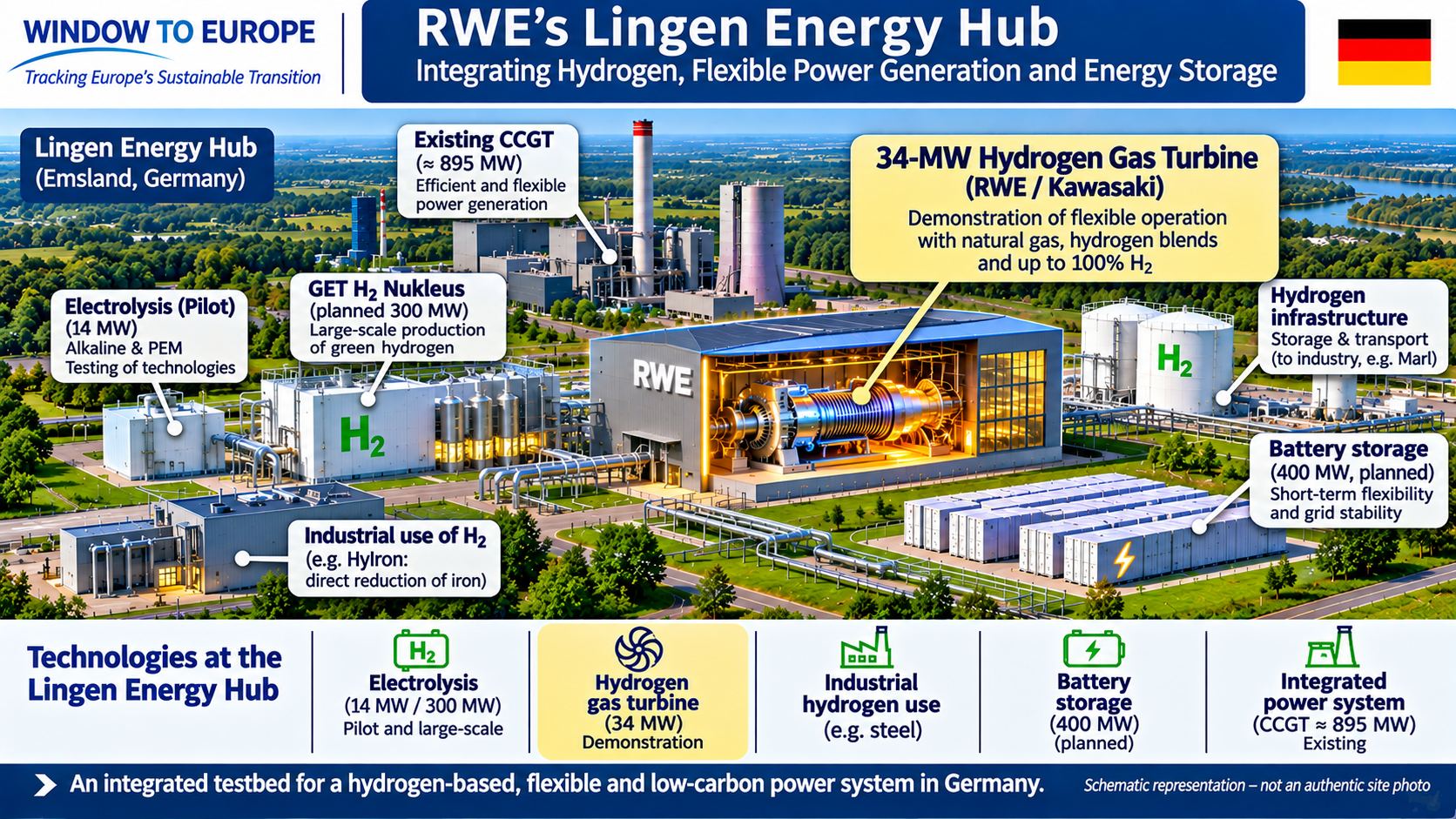
RWE’s Lingen Energy Hub is becoming a testbed for integrating hydrogen production, industrial supply, flexible electricity generation and energy storage. At its Emsland site in Germany, RWE combines existing gas-fired power generation with a 14 MW pilot electrolyser, the larger GET H₂ Nukleus project and hydrogen transport infrastructure. A 400 MW battery storage facility is also planned to provide additional flexibility.
In November 2026, RWE and Japan’s Kawasaki Heavy Industries began trial operations with a 34 MW gas turbine designed to operate on natural gas, hydrogen or mixtures containing up to 100% hydrogen. Supported by Japan’s NEDO, the project will investigate operational flexibility, emissions and reliability. Sustained operation on pure hydrogen remains to be demonstrated.
Perspective: Lingen illustrates how different technologies can complement each other in a future low-carbon energy system. The hydrogen turbine is an important demonstration within RWE’s broader strategy, rather than a stand-alone technological breakthrough.
Further reading – technologies, partners and outstanding questions
1. Lingen as an integrated energy site
RWE’s Emsland power station provides the industrial setting for several related but distinct activities. The existing gas-fired generation infrastructure is complemented by hydrogen electrolysis and the development of supply connections to industrial users. The 14 MW pilot electrolyser serves technology testing, while the GET H2 Nukleus project is designed for substantially larger hydrogen production. Project capacity, construction status and operational output must not be conflated.
Source: RWE – Lingen energy site.
2. What the 34 MW turbine demonstrates
On 6 November 2026, RWE and Kawasaki announced the start of trial operations with a 34 MW gas turbine at Lingen. Developed by Kawasaki in Japan, the turbine is designed for flexible operation with natural gas, hydrogen and blends up to 100% hydrogen. NEDO supports the demonstration. The trials are intended to assess combustion behaviour, emissions, load flexibility and reliable operation under industrial conditions.
Important distinction: commissioning the facility is not the same as proving sustained commercial operation with 100% hydrogen. The demonstration must deliver that evidence.
Source: RWE – trial operations begin, 6 November 2026.
3. Hydrogen production and industrial supply
Hydrogen can connect electricity production with industrial demand. Lingen’s electrolysis activities are therefore relevant beyond the power station itself. Transport infrastructure can enable supply to industrial consumers, while the gas turbine investigates the reverse route: using hydrogen to generate electricity when required. These uses have different economic and efficiency profiles and should be assessed separately.
Source: RWE – hydrogen activities at Lingen.
4. Batteries and flexible power plants: complementary roles
| Technology | Main system function | Qualification |
|---|---|---|
| Renewable generation | Primary low-carbon electricity supply | Output varies with weather |
| Batteries | Fast response and short-duration flexibility | Energy capacity limits discharge duration |
| Electrolysis | Hydrogen production for industrial use or storage | Requires electricity and downstream infrastructure |
| Hydrogen-capable gas turbines | Dispatchable power during longer supply gaps | Hydrogen availability, efficiency and emissions matter |
RWE is developing a diversified portfolio of renewables, batteries, electrolysis and hydrogen-compatible gas-fired power generation. Lingen should be understood in that wider context. Hydrogen-to-power involves significant conversion losses; its potential advantage is dispatchability over periods when short-duration storage is insufficient.
5. The international technology partnership
Kawasaki supplies the Japanese gas turbine technology; RWE provides the European industrial operating environment and energy infrastructure. NEDO’s involvement reflects Japan’s interest in demonstrating its hydrogen technologies abroad. The Lingen project is thus both a German system-integration experiment and an international technology demonstration.
Source: RWE/Kawasaki announcement.
6. What remains to be demonstrated?
The key questions are sustained hydrogen operation, nitrogen oxide emissions, equipment durability, flexibility during load changes and the availability and cost of low-emission hydrogen. A successful test would support the case for hydrogen-compatible flexible power, but would not by itself establish the economics of large-scale hydrogen electricity generation.
View from Japan
The turbine builds on Japanese hydrogen-combustion research and earlier Kawasaki demonstrations in Kobe. Our companion article on Window-to-Japan, “From Kobe to Lingen: Japan’s Hydrogen Turbine Technology Goes International”, examines the technology pathway and research partnerships. [Insert link to the W2J article after publication.]
Sources
RWE, 6 November 2026 · RWE, Lingen site information · NEDO, 9 November 2026.