
In brief
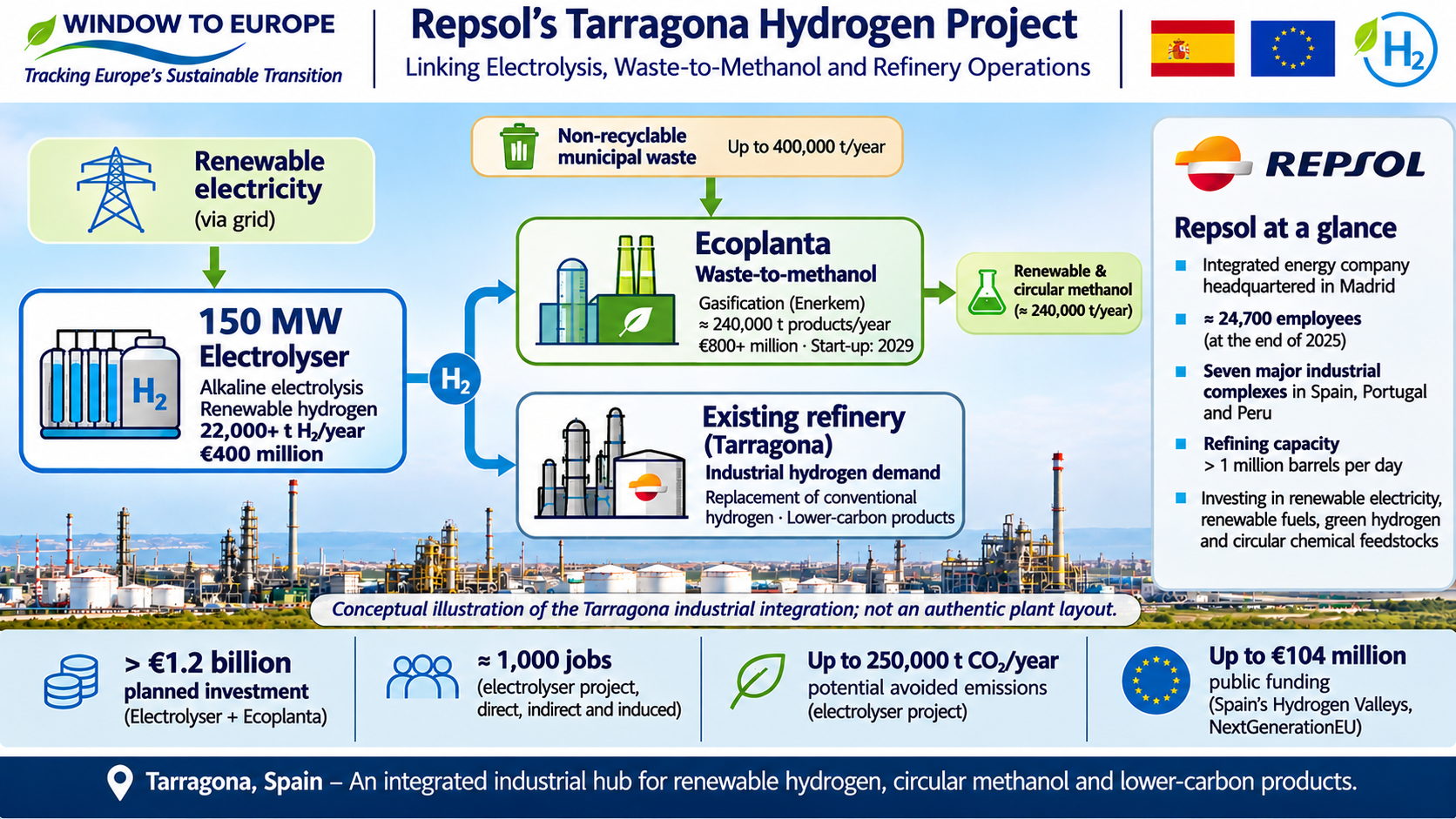
Repsol and Enagás Renovable have approved the development of a 150 MW renewable hydrogen electrolyser at Repsol’s Tarragona industrial complex in Spain. The approximately €400 million investment, announced on 12 November 2026, is designed to produce more than 22,000 tonnes of renewable hydrogen annually, primarily for the nearby Ecoplanta and existing refinery operations.
The project will link large-scale electrolysis with industrial hydrogen demand and the conversion of non-recyclable municipal waste into renewable and circular methanol. Repsol estimates potential avoided emissions of up to 250,000 tonnes of CO₂ per year. It has been selected for up to €104 million in public funding through Spain’s Hydrogen Valleys programme, supported by NextGenerationEU.
Together with the separately approved Ecoplanta, representing an investment of more than €800 million, the two projects account for over €1.2 billion in planned investment in Tarragona’s industrial transformation.
Source: Repsol and Enagás Renovable, 12 November 2026; Repsol, 29 January 2025.
Further reading
Repsol at a glance
Headquartered in Madrid, Repsol is one of Europe’s major integrated energy companies, with operations spanning oil and gas production, refining, petrochemicals, electricity generation and energy distribution.
The company employed approximately 24,700 people at the end of 2025 and operates seven major industrial complexes in Spain, Portugal and Peru, with a combined refining capacity exceeding one million barrels per day.
While conventional oil and gas remain central to its business, Repsol is investing in renewable electricity, renewable fuels, green hydrogen and circular chemical feedstocks. Its strategy includes transforming existing refineries into integrated multi-energy industrial hubs.
Tarragona is a particularly illustrative example of this approach, combining established petrochemical infrastructure with renewable hydrogen production and the planned Ecoplanta waste-to-methanol facility.
Sources:
Repsol, 2025 Consolidated Management Report;
Repsol, Our Company;
Repsol, Strategic Plan 2026–2028.
1. A 150 MW electrolyser for an existing industrial complex
The Tarragona electrolyser will be developed jointly by Repsol (75%) and Enagás Renovable (25%). Enagás Renovable is owned by Hy24 (80%) and Enagás (20%). The project is expected to generate approximately 1,000 direct, indirect and induced jobs during its development phases, predominantly in the region.
The installation will use reclaimed industrial water rather than freshwater supplies. Its hydrogen output will primarily serve Ecoplanta and refinery processes, replacing or supplementing conventional hydrogen in the manufacture of lower-carbon-footprint products.
Repsol also identifies potential future connections to the natural gas network and the Spanish Hydrogen Backbone, although these are not confirmed hydrogen deliveries.
Source: Repsol and Enagás Renovable, 12 November 2026.
2. Ecoplanta: converting municipal waste into methanol
At El Morell, within Tarragona’s industrial area, Repsol is developing the Ecoplanta project using gasification technology developed with Canadian technology company Enerkem.
- Investment: more than €800 million.
- Feedstock capacity: up to 400,000 tonnes per year of municipal solid waste and other eligible feedstocks.
- Planned output: approximately 240,000 tonnes per year of renewable and circular methanol and related products.
- Targeted start-up: 2029.
- Employment: approximately 2,800 jobs during construction and 340 direct, indirect and induced jobs during operation.
The gasification process converts carbon-containing waste into synthesis gas, which can subsequently be processed into methanol. Renewable methanol is associated with the biogenic fraction of the feedstock, while circular methanol can originate from non-biogenic materials, including non-recyclable plastics.
Repsol confirms that the new electrolyser will supply renewable hydrogen to Ecoplanta. However, detailed hydrogen allocation, process integration and the overall carbon balance have not yet been published.
Ecoplanta has been selected for support under the European Innovation Fund. According to Repsol, the European Commission estimates potential greenhouse gas emissions reductions equivalent to 3.4 million tonnes of CO₂ during the first ten years of operation. This projection should be distinguished from the separately announced annual savings attributed to the electrolyser.
Sources: Repsol, 29 January 2025; Repsol, Ecoplanta technical overview.
3. Financing and the regional hydrogen economy
The electrolyser has been selected for up to €104 million in funding through Spain’s Hydrogen Valleys programme, part of the Recovery, Transformation and Resilience Plan financed by NextGenerationEU. This is a funding selection, not evidence that the full amount has already been disbursed.
The project forms part of the wider industrial transformation of northeastern Spain, including the Catalonia Hydrogen Valley and the Ebro Hydrogen Corridor. These initiatives aim to connect hydrogen production, industrial demand and infrastructure development.
Repsol’s strategy is to locate renewable hydrogen production close to established industrial consumers, potentially reducing the need to create entirely new demand before production begins.
Source: Repsol and Enagás Renovable, 12 November 2026.
4. Part of a wider industrial hydrogen programme
Tarragona will be Repsol’s third large-scale electrolyser project, following previously announced 100 MW projects in Cartagena and at Petronor near Bilbao. Together, the three facilities represent 350 MW of planned electrolyser capacity.
The company has also developed smaller hydrogen installations, including the 2.5 MW electrolyser operating at Petronor since 2023. The transition from pilot-scale and smaller industrial systems to plants of 100–150 MW represents a substantial scale-up.
Source: Repsol and Enagás Renovable, 12 November 2026.
5. Commercial opportunities and outstanding questions
Ecoplanta already has an identified potential market for renewable methanol. In 2025, Repsol announced an agreement with Norwegian Cruise Line Holdings to supply renewable fuels, including future methanol from Tarragona. This provides a commercial perspective beyond internal refinery consumption.
Nevertheless, several important details remain unresolved. The November 2026 announcement does not identify the electrolyser supplier, confirm the final electrolysis technology or provide a binding commissioning date.
Moreover, the projected annual CO₂ savings require careful interpretation. Their verification will depend on the electricity supply, plant utilisation, hydrogen production efficiency, displaced conventional hydrogen and the boundaries used in lifecycle accounting.
Sources: Repsol, Norwegian Cruise Line Holdings agreement, 2025; Repsol and Enagás Renovable, 2026.
Outlook
Tarragona illustrates a practical approach to industrial decarbonisation: integrating renewable hydrogen production, waste-derived carbon feedstocks and established refinery infrastructure within a single industrial region.
Its significance lies not only in the scale of the electrolyser but in the potential combination of renewable electricity, circular carbon and existing industrial demand.
The decisive next steps will be construction progress, confirmation of the electrolyser technology and supplier, commissioning schedules and evidence of actual emissions reductions.