
Green C/H | New Bioproducts | Estonia – Sweden – Japan
In brief
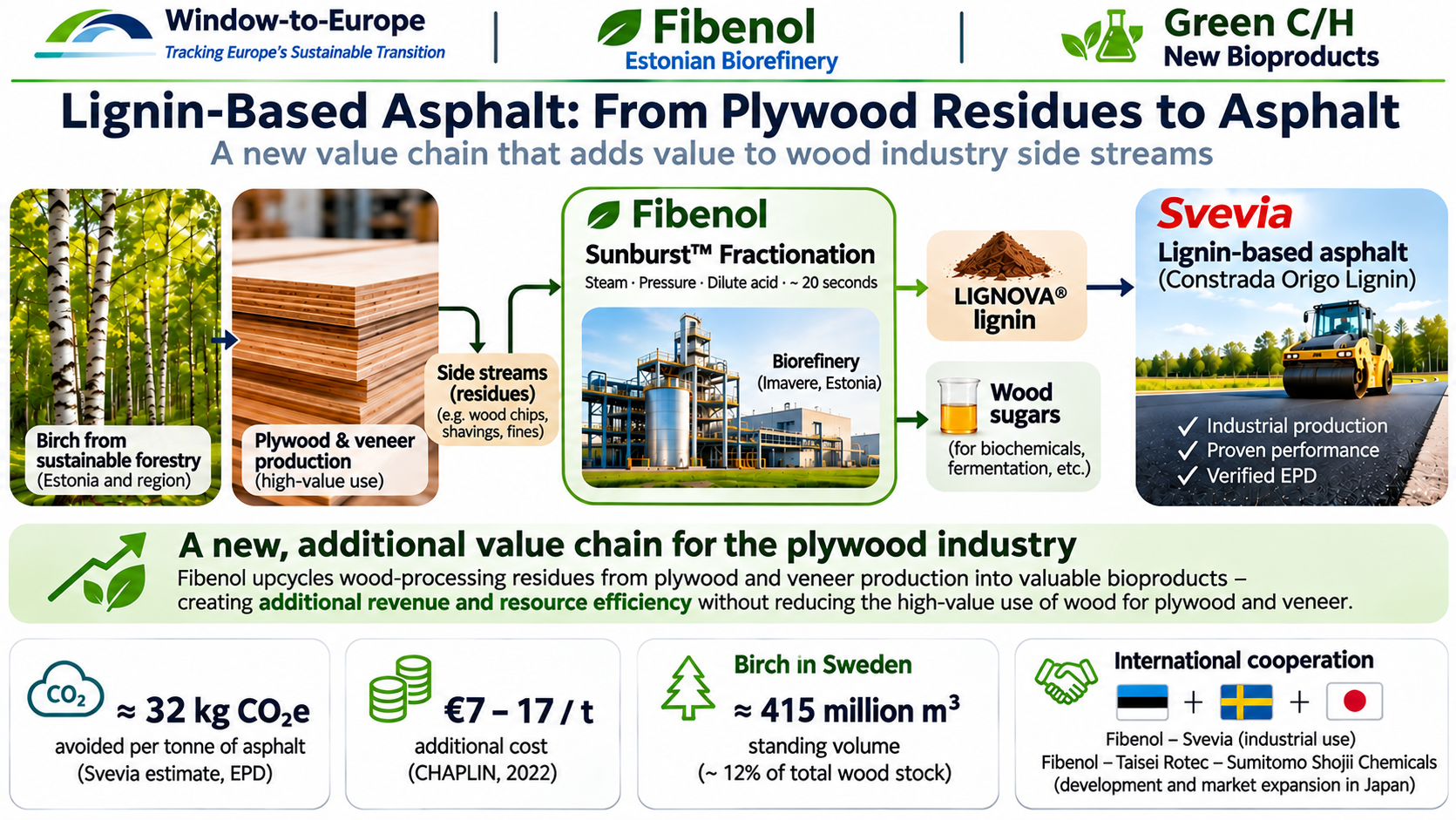
In October 2026, Swedish road builder Svevia reported that industrial production of its lignin-containing asphalt, Constrada Origo Lignin, was operational at Läggesta near Mariefred. The material replaces part of petroleum-derived bitumen with wood-based lignin. Estonian biorefinery company Fibenol supplies a promising route to this ingredient through its Sunburst™ fractionation technology.
The distinctive value proposition is an additional value chain built on residues from existing plywood and veneer production. Rather than growing or harvesting trees solely for asphalt, Fibenol can upgrade suitable birch-processing by-products into lignin for materials and sugars for further processing. The primary wood products remain the main output of the timber industry; the biorefinery adds value to residual streams. The commercial benefit depends on feedstock contracts, processing costs and markets for all fractions.
Industrial asphalt manufacturing is now demonstrated, but publicly available figures do not yet establish sustained profitability or large-volume market penetration. Dutch studies previously estimated additional costs of €7–17 per tonne of lignin-containing asphalt, depending on assumptions and formulation; this is not a current price quotation for Svevia’s product.
Further reading
1. From plywood residues to high-value products
Fibenol’s biorefinery at Imavere, Estonia, primarily targets hardwood residues, particularly birch by-products associated with regional wood processing, including plywood and veneer manufacture. This distinction is central to its industrial logic. Plywood production creates valuable structural products first; suitable residual wood fractions then become feedstock for a second, complementary materials industry. It is an opportunity for additional resource efficiency and revenue from an existing industrial side stream, rather than a claim that all wood residues are otherwise wasted. Residues may already have competing uses, including energy or pulp.
Sunburst™ fractionation uses a short steam/pressure-assisted pretreatment, with dilute acid, to open the lignocellulosic structure. Subsequent separation and enzymatic processing yield a lignin-rich product marketed as LIGNOVA® and carbohydrate streams that can serve as fermentation feedstocks. The technology therefore produces several potential revenue streams rather than depending exclusively on the asphalt market.
Sources: CBE JU – SWEETWOODS; GEA – Fibenol process equipment.
2. Industrial asphalt production in Sweden
Svevia announced in October 2026 that production of Constrada Origo Lignin was operating at its Läggesta asphalt plant. The installation integrates storage and controlled dosing of powdered lignin into conventional asphalt manufacturing. Reusing the existing plant reduces the need for a completely new manufacturing infrastructure. Lignin replaces a proportion of the fossil bitumen binder, not the entire asphalt mixture.
According to Svevia, its product offers performance comparable to conventional asphalt and has an independently verified Environmental Product Declaration. Reported climate benefits must be read with their stated system boundaries: a production-stage assessment (A1–A3) is not the same as a full road-life-cycle assessment. Svevia has cited an indicative saving of approximately 320 tonnes of CO₂-equivalent for 10,000 tonnes of asphalt, or around 32 kg per tonne, under its specified assumptions.
Sources: Svevia – Industrial production, 7 October 2026; Svevia – Constrada Origo Lignin.
3. Economics: value creation, not yet proven price parity
The economic case has two distinct components. First, Fibenol may create additional value from suitable plywood-industry by-products by producing saleable lignin and sugars. Second, asphalt producers must obtain lignin at a delivered price that justifies partial replacement of bitumen, including any handling and dosing costs. Both conditions are necessary for a durable commercial market.
Earlier Dutch CHAPLIN analyses estimated extra costs of roughly €7–17 per tonne of asphalt mixture including paving, depending on the scenario. These historical results should not be treated as the selling price or profit margin of Fibenol or Svevia in 2026. The key missing commercial indicators are contracted lignin volumes, delivered lignin prices, asphalt plant throughput, long-term pavement performance and actual repeat orders.
Potential climate benefits may strengthen the case in public procurement, but they cannot substitute for verified durability and life-cycle cost performance. The strongest industrial argument is that a multiproduct biorefinery can spread feedstock and operating costs across several products, while existing asphalt plants can be adapted rather than replaced.
Source: Wageningen University & Research – CHAPLIN research.
4. Could Sweden supply the birch residues?
Sweden has extensive birch resources, but standing timber volume should not be confused with an available supply of plywood-processing residues. Much of Sweden’s industrial birch roundwood is directed to pulp production, whereas Estonia and Latvia have more established birch plywood and veneer supply chains. Thus, the availability of birch trees alone does not demonstrate that a Swedish Sunburst-type plant could immediately source comparable residues at competitive cost.
A Swedish biorefinery could eventually use suitable local hardwood side streams or establish partnerships with wood processors, subject to feedstock specifications, transport distances, competing uses and investment economics. In the meantime, Swedish asphalt production can be supplied with lignin produced elsewhere, including Estonia. No Swedish Sunburst plant is implied by the Läggesta asphalt investment.
Background: Swedish University of Agricultural Sciences – Birch utilisation study; Skogforsk – Birch from forest to construction.
5. Cooperation with Japan
Japan provides an additional route to market and technical validation. Fibenol has reported cooperation with Sumitomo Shoji Chemicals to develop markets for LIGNOVA® and other wood-based materials, and with road engineering company Taisei Rotec on lignin-containing asphalt. The Japanese collaboration links Estonian biorefinery output to expertise in asphalt formulation, mixing and road performance testing.
Initially, the collaboration concerns Fibenol’s lignin produced from its Estonian feedstock. It should not be interpreted as evidence that Japanese pine is already used in Sunburst production. A future shift to locally sourced Japanese biomass would require verification of species, lignin properties and process suitability. Hardwood lignin and softwood lignin differ chemically; asphalt recipes cannot simply be transferred without testing.
Sources: Sumitomo Shoji Chemicals – Fibenol cooperation; Trade with Estonia – Taisei Rotec collaboration.
6. Outlook: an additional industrial value chain
The most important lesson extends beyond asphalt. Fibenol illustrates how an established wood-products sector can support a new biobased materials industry through the cascade use of suitable processing by-products. Plywood and veneer remain high-value primary products; fractionation creates an additional route from residual biomass to lignin-based materials and fermentation substrates.
Svevia’s operational production line shows that lignin-containing asphalt can be manufactured at industrial scale. Whether it becomes a mainstream road material will depend on competitive supply chains, independently demonstrated long-term performance, credible life-cycle assessments and sustained demand. The next meaningful milestone is not another test road, but documented recurring sales at commercially viable costs.