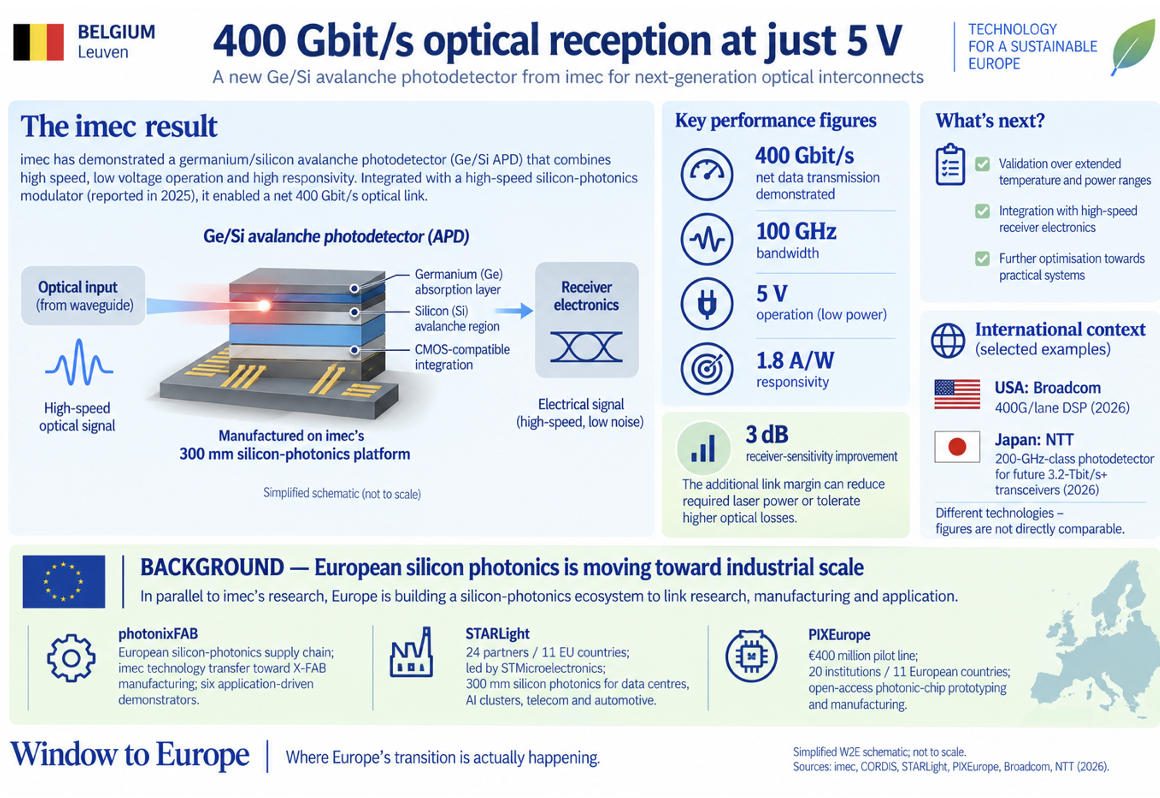
Belgium’s imec has demonstrated a new germanium/silicon avalanche photodetector combining 100 GHz bandwidth, low-voltage operation and high sensitivity. Integrated with a high-speed silicon-photonics modulator, it enabled net 400 Gbit/s optical transmission – a step towards faster and potentially more energy-efficient optical links for AI data centres.
The new Ge/Si avalanche photodetector (APD), manufactured on imec’s 300 mm silicon-photonics platform, operates at 5 V with a responsivity of 1.8 A/W. Combined with a >110 GHz Ge/Si electro-absorption modulator demonstrated by imec in 2025, the device achieved a net data rate of 400 Gbit/s.
The APD improves receiver sensitivity by 3 dB compared with a conventional photodiode. According to imec, this additional link margin can be used either to tolerate greater optical losses or to reduce the required laser power – an important consideration as data traffic and energy consumption in AI data centres increase. Further work will focus on reliability over extended operating conditions and integration with high-speed receiver electronics.
Background information: The new APD is not presented by imec as the result of a specific EU programme or industrial consortium. In parallel, however, Europe is building an industrial silicon-photonics infrastructure. The EU-funded photonixFAB project is transferring imec technology towards industrial manufacturing at X-FAB and includes six application-driven demonstrators; its partners span research, manufacturing, packaging and companies including Nokia, NVIDIA and Thales.
Two larger initiatives extend this effort. STARLight, led by STMicroelectronics, brings together 24 partners from 11 EU countries to develop 300 mm silicon photonics and high-volume manufacturing for applications including data centres and AI clusters. PIXEurope is establishing an open-access European photonic-chip pilot line with a €400 million budget and 20 institutions from 11 countries, covering technologies from prototyping to integration and manufacturing.
International competition is moving rapidly as well. In Japan, NTT demonstrated a 200-GHz-class photodetector in 2026 aimed at future optical transceivers of 3.2 Tbit/s and beyond. US companies are likewise developing 400-Gbit/s-per-lane technology. These approaches and performance figures are not directly comparable with imec’s APD, but they illustrate the international race towards faster optical interconnects.
Sources:
imec – 400 Gbit/s APD, 21 September 2026 · photonixFAB – CORDIS · STARLight – imec · PIXEurope · NTT – 200-GHz photodetector