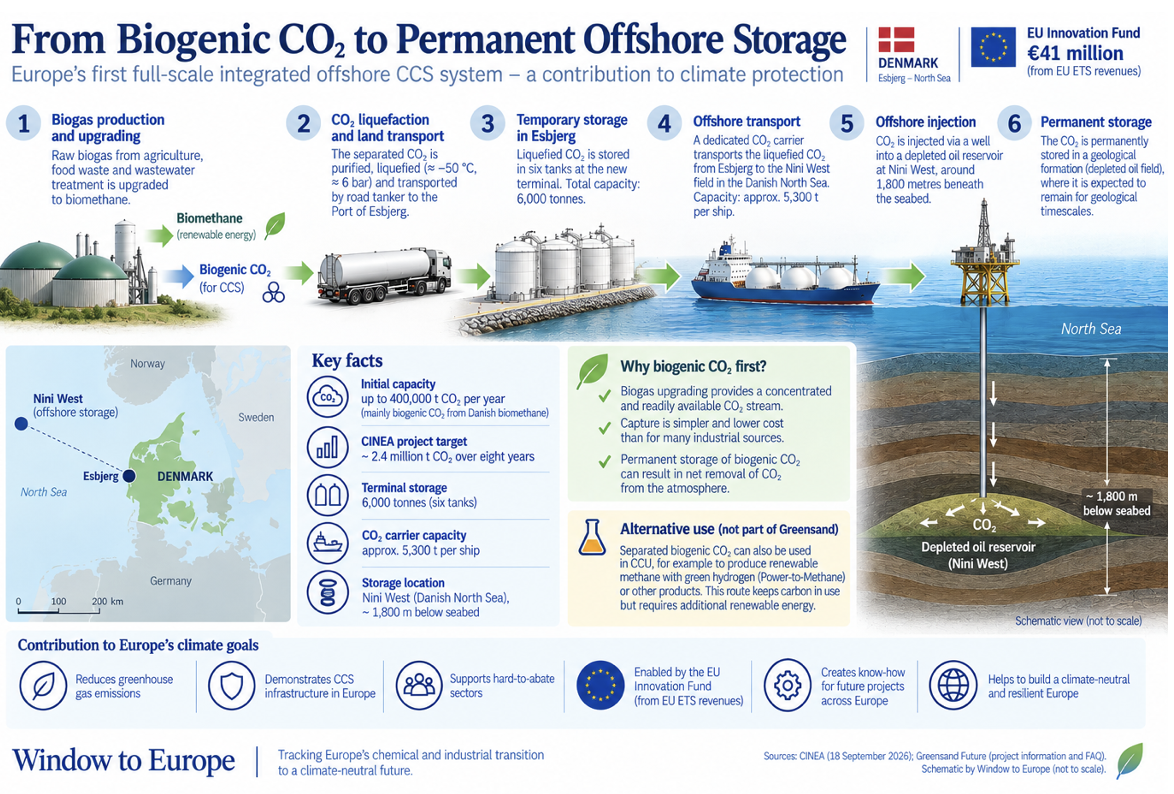
Greensand Future was inaugurated at the Port of Esbjerg on 18 September 2026 as a new piece of European climate-protection infrastructure. In its initial phase, the project will mainly handle CO₂ separated during Danish biomethane production.
In this project, a relatively concentrated and readily available biogenic CO₂ stream is being used while capture from many fossil industrial sources is still being scaled up.
The CO₂ is liquefied, transported to Esbjerg and shipped to the Nini West field in the Danish North Sea, where it is injected into a depleted oil reservoir for permanent geological storage. Initial capacity is up to about 400,000 tonnes per year; CINEA expects around 2.4 million tonnes over eight years. The project is supported by a €41 million grant from the EU Innovation Fund.
Using biogenic CO₂ makes the climate effect particularly interesting: carbon previously taken up from the atmosphere is permanently removed rather than re-emitted. But storage is not the only possible route. Separated biogenic CO₂ could alternatively be used as a carbon feedstock, for example for methane production with renewable hydrogen. That CCU pathway requires additional renewable energy and is not part of Greensand. Greensand plans eventually to store both biogenic and fossil CO₂.