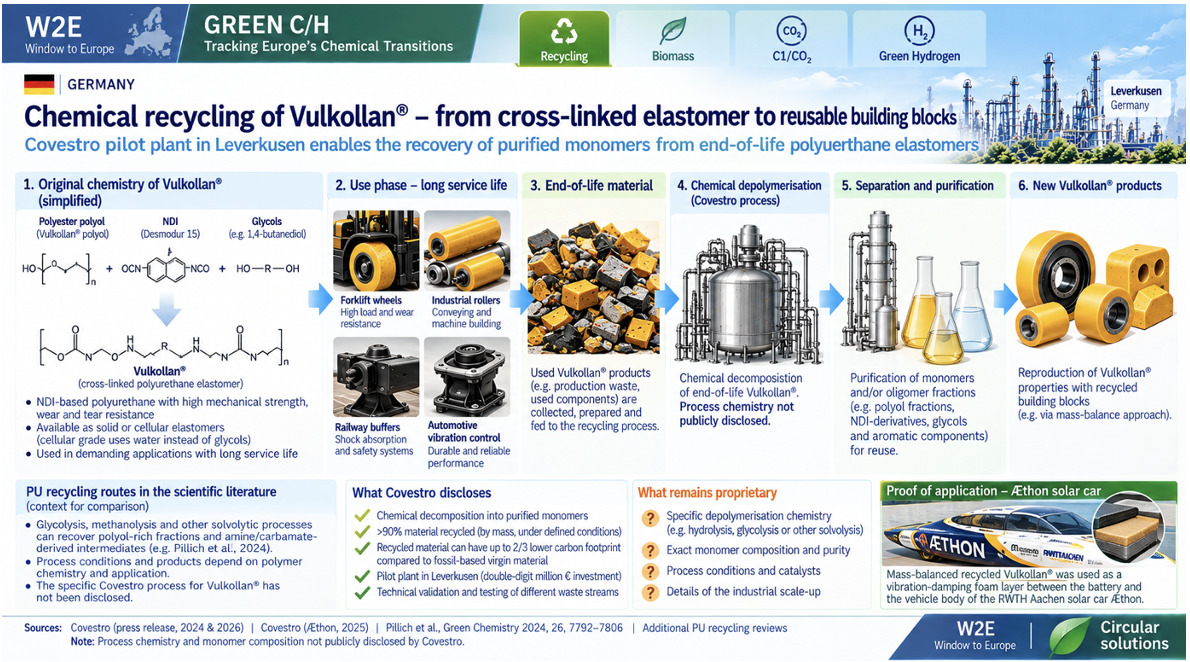
Can high-performance polyurethane elastomers become truly circular? Covestro has opened a pilot plant in Leverkusen that chemically breaks down end-of-life Vulkollan® into purified building blocks for reuse. The project takes polyurethane recycling beyond the more familiar field of foams – into durable, cross-linked materials designed to withstand years of demanding industrial service.
Covestro has opened a pilot plant in Leverkusen for the chemical recycling of Vulkollan®, a family of high-performance polyurethane elastomers. The double-digit million-euro investment takes a process developed on laboratory scale into technical validation and is intended to provide the data required for possible industrial scale-up.
Vulkollan® is based on polyester polyols and 1,5-naphthalene diisocyanate (NDI, Desmodur® 15). Solid elastomers are produced using glycols as chain extenders, while cellular grades use water. The resulting cross-linked polyurethane combines high mechanical strength with exceptional resistance to wear and is used, for example, in forklift wheels, industrial rollers, railway buffers and vibration-control components.
This durability also makes end-of-life recycling challenging. Unlike thermoplastics, cross-linked polyurethane elastomers cannot simply be melted and remoulded. Covestro therefore chemically decomposes selected Vulkollan® waste streams into chemical building blocks, followed by separation and purification. The company reports recovery of purified monomers but has not disclosed the specific depolymerisation chemistry, catalysts, process conditions or detailed composition of the recovered fractions.
Solvolytic processes such as glycolysis and methanolysis are well established in polyurethane recycling research and can yield polyol-rich fractions as well as amine- or carbamate-derived intermediates. Related work by Covestro, RWTH Aachen and other partners has investigated such chemical recycling approaches particularly for polyurethane foams. However, these processes should not be assumed to describe the proprietary Vulkollan® recycling route.
Under defined conditions, Covestro reports that more than 90% of selected end-of-life Vulkollan® can be recycled by mass. The company also estimates that material produced with recycled building blocks can have a carbon footprint up to two-thirds lower than fossil-based virgin material. Both figures are company data and will now have to be validated across different waste streams and ultimately at industrial scale.
A first application has already demonstrated how recovered material can re-enter a high-performance product. Mass-balanced recycled Vulkollan® was used in the RWTH Aachen solar car Æthon as a vibration-damping foam layer between the battery and the vehicle body. The mass-balance approach means that recycled feedstock is attributed to the product within an integrated production system rather than implying that the component consists exclusively of physically segregated recycled molecules.
The Leverkusen pilot therefore addresses more than depolymerisation chemistry. Feedstock collection, consistent waste quality, purification, logistics and economics will determine whether the process can ultimately develop into an industrial circular value chain for long-lived polyurethane elastomers.
Sources
- Covestro (2026): Toward circular elastomers: Covestro opens pilot plant in Leverkusen.
Covestro – pilot plant, September 2026 - Covestro (2024): Covestro invests in pilot plant for recycling of elastomers..
Covestro – original project announcement, December 2024 - Covestro: NDI-based elastomers / Vulkollan chemistry.
Covestro – NDI-based elastomer chemistry - Covestro (2025/26): Covestro Æthon solar car.
Covestro – materials in the Æthon solar car - Rossignolo, G.; Malucelli, G.; Lorenzetti, A. (2024): “Recycling of polyurethanes: where we are and where we are going.” Green Chemistry 26, 1132–1152. DOI 10.1039/D3GC02091F.
Green Chemistry – PU recycling review - Pillich, M.; Schilling, J.; Bosetti, L.; Bardow, A. (2024): “What to do with polyurethane waste? The environmental potential of chemically recycling polyurethane rigid foam.” Green Chemistry 26, 10893–10906. DOI 10.1039/D4GC02594F.
Green Chemistry – Pillich et al. 2024
Note: The specific depolymerisation chemistry, catalysts, operating conditions and composition of the recovered Vulkollan® fractions have not been publicly disclosed by Covestro. References to glycolysis, methanolysis or other solvolytic routes describe the broader scientific context of polyurethane recycling and not necessarily the process used in Leverkusen.