
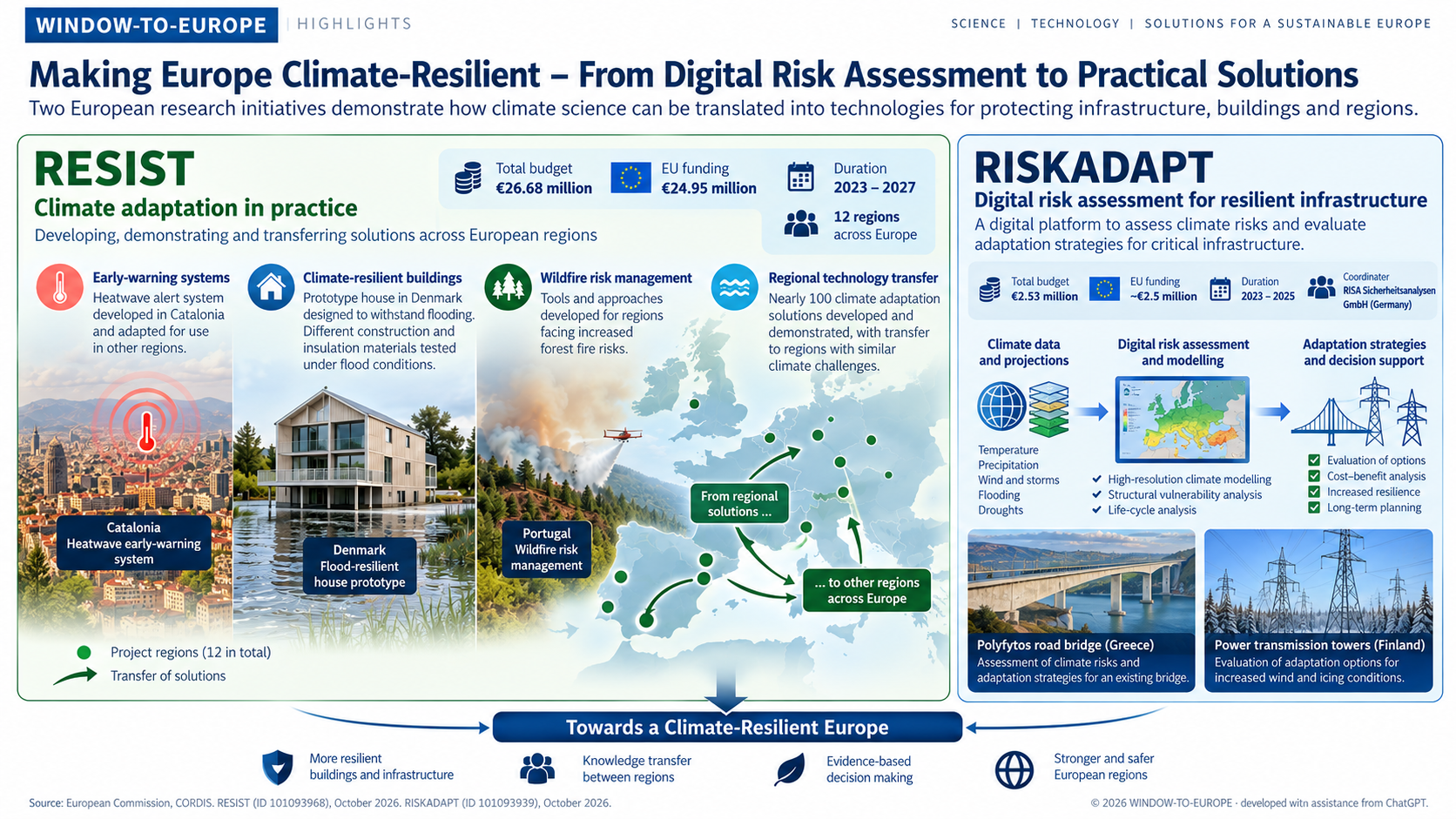
Illustrative representation of the two projects and their selected applications; images are not necessarily depictions of the actual demonstration sites.
Making Europe Climate-Resilient – From Digital Risk Assessment to Practical Solutions
Two European research initiatives demonstrate how climate science can be translated into technologies for protecting infrastructure, buildings and regions.
In brief
As Europe faces increasing risks from heatwaves, flooding, wildfires and extreme weather, two EU-funded research initiatives demonstrate complementary approaches to climate adaptation. RESIST focuses on practical solutions and their transfer between European regions, while RISKADAPT combines climate modelling with digital tools to assess infrastructure risks and evaluate adaptation strategies.
Together, the two projects have combined budgets of approximately €29.2 million, illustrating how European research and innovation funding can support practical climate resilience.
RESIST – Bringing Climate Adaptation into Practice
The RESIST project (2023–2027), supported by the EU’s Horizon Europe programme, has a total budget of €26.68 million, including €24.95 million in EU funding.
The project brings together 12 European regions to develop, demonstrate and exchange solutions for climate adaptation. Its activities cover early-warning systems, flood-resilient buildings, wildfire risk management and the transfer of adaptation technologies between regions.
Examples include a heatwave early-warning system developed in Catalonia and adapted for use in other European regions, as well as a prototype flood-resilient house in Denmark, where different construction and insulation materials have been tested under flooding conditions.
A central objective is to make successful local solutions available to other European regions facing similar climate challenges. RESIST thus combines technological demonstration with cross-border knowledge transfer and regional implementation.
Source: European Commission, CORDIS: RESIST – Project 101093968. Project description, funding and results.
RISKADAPT – From Climate Modelling to Infrastructure Protection
RISKADAPT (2023–2025) was coordinated by RISA Sicherheitsanalysen GmbH, Germany, with a total project budget of €2.53 million, largely financed through Horizon Europe.
The project developed a digital platform that integrates climate projections, structural vulnerability assessment and life-cycle analysis to support climate-resilient infrastructure planning.
Climate modelling provides the scientific foundation. Projections of changing temperatures, precipitation, storms, flooding and other climate-related hazards are used to assess how infrastructure may be affected under future conditions.
These projections are combined with engineering models to evaluate structural vulnerability and identify potential risks. Life-cycle analysis then helps compare possible adaptation measures, taking account of their long-term performance and implications.
The methods were tested on real infrastructure, including the Polyfytos road bridge in Greece and electricity transmission towers in Finland. For the latter, adaptation strategies were evaluated against changing wind and icing conditions.
RISKADAPT thus demonstrates a progression from climate data and projections through digital risk assessment to evidence-based adaptation decisions. Its contribution lies not in constructing new infrastructure, but in improving the scientific and technical basis for protecting existing assets.
Source: European Commission, CORDIS: RISKADAPT – Project 101093939. Project description, consortium, funding and results.
From Research to Climate Resilience
Together, RESIST and RISKADAPT illustrate two complementary elements of Europe’s response to climate change.
RESIST concentrates on practical solutions, regional demonstrations and the transfer of adaptation technologies. RISKADAPT provides digital methods for understanding climate risks and selecting appropriate engineering responses.
Although the technologies are at different stages of development and validation, both projects deliver tangible results beyond policy declarations and project planning.
They also highlight an important European strength: cooperation across national borders, enabling scientific knowledge, engineering expertise and technological solutions to be shared between regions.
Climate resilience is becoming an increasingly important dimension of Europe’s sustainable transition – alongside decarbonisation, resource efficiency and the development of renewable energy systems.
Figure: Illustrative representation of RESIST and RISKADAPT and selected applications. Images do not necessarily depict actual demonstration sites.