
In brief
Greece has inaugurated its largest standalone battery energy storage facility, marking a significant step towards a more flexible electricity system.
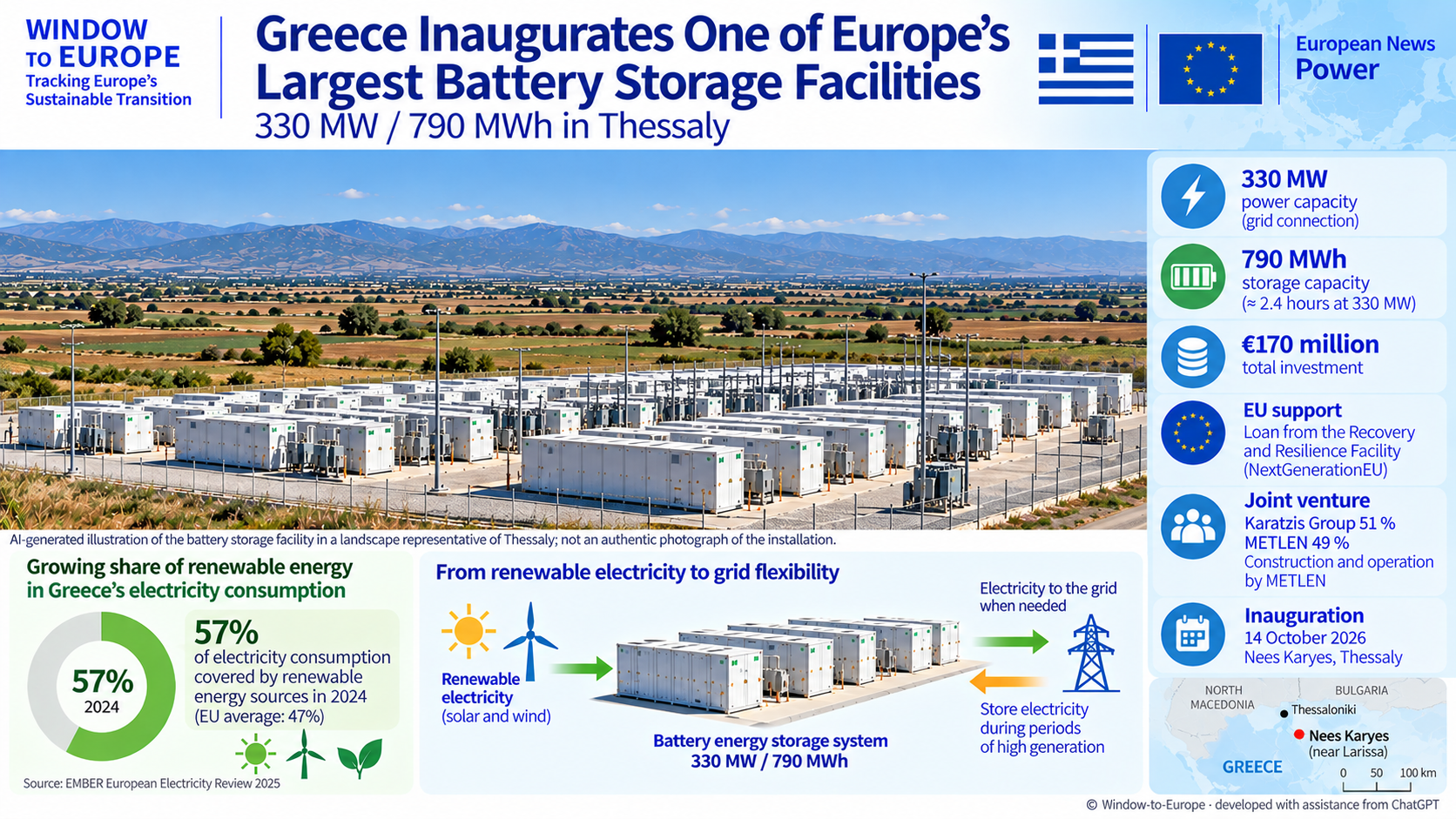
The installation near Larissa, in the region of Thessaly, has a power capacity of 330 MW and an energy storage capacity of 790 MWh. Developed jointly by the Greek companies METLEN and Karatzis Group, it is among the largest standalone battery storage installations in Europe.
The facility was officially inaugurated on 14 October 2026, following completion and commissioning. The project represents an investment of approximately €170 million, supported by a loan from the European Union’s Recovery and Resilience Facility.
Source: METLEN, 15 October 2026
From Renewable Electricity to Grid Flexibility
As Greece expands solar and wind generation, electricity storage is becoming an increasingly important component of its energy infrastructure.
Large battery systems can absorb electricity when renewable generation exceeds immediate demand and release it when demand rises or generation declines. They can also provide services that help maintain the stability of the electricity grid.
The Thessaly facility provides 790 MWh of electrical storage capacity. At its rated output of 330 MW, this corresponds to a theoretical discharge duration of approximately 2.4 hours, before accounting for operational constraints and conversion losses.
This makes the installation particularly relevant for balancing short-term variations in electricity supply and demand.
Its contribution will depend on actual operating strategies, market conditions and the services provided to the Greek transmission system.
Two Greek Industrial Groups Join Forces
The facility was developed through a joint investment company owned by:
- Karatzis Group – 51%
- METLEN – 49%
METLEN was responsible for construction and will also undertake operation and maintenance.
The partnership combines METLEN’s international experience in energy infrastructure and battery storage with Karatzis Group’s growing activities in renewable energy.
Both companies are established industrial groups, making the project an example of how European industry is investing directly in infrastructure needed for the energy transition.
The €170 million investment received loan support through NextGenerationEU, the European Union’s Recovery and Resilience Facility.
Source: Karatzis Group, 16 October 2026
A Major Addition to Greece’s Energy Infrastructure
The new installation is located in Thessaly, a region with substantial renewable-energy activity.
According to METLEN, it is the largest standalone battery storage facility in Greece and one of the largest in the European Union.
According to industry reports, the battery storage technology was supplied by Jinko ESS, a Chinese manufacturer of energy storage systems associated with JinkoSolar. The project thus illustrates how European energy infrastructure development increasingly combines local investment and engineering with battery technologies supplied by international manufacturers.
The project illustrates a broader development in European electricity systems: as renewable generation expands, investment is increasingly moving beyond solar panels and wind turbines towards storage, grid connections and other flexibility technologies.
Battery storage cannot replace all forms of long-duration energy storage, but it can respond rapidly to changes in electricity supply and demand.
The Thessaly facility demonstrates that grid-scale storage is progressing from project development to completed infrastructure at a scale relevant to national electricity systems.
European Significance
The European energy transition depends not only on generating more renewable electricity, but also on making that electricity available when and where it is needed.
Large battery installations can help reduce renewable-energy curtailment, improve short-term system flexibility and support the integration of variable electricity generation.
The Thessaly project is therefore more than an individual investment. It is an example of how European companies are building the infrastructure required for an electricity system increasingly based on renewable energy.
The decisive milestone is that the facility has now been built and inaugurated. Its longer-term contribution to grid stability, renewable-energy integration and economic performance will become clearer as operational experience accumulates.